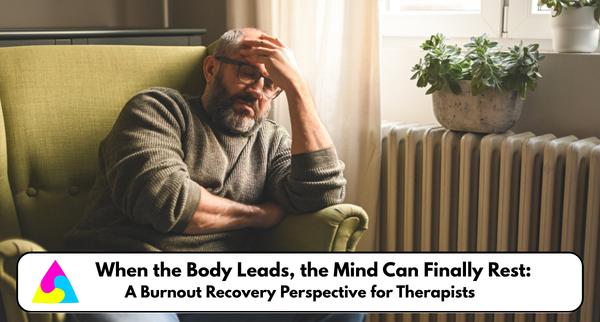
When the Body Leads, the Mind Can Finally Rest: A Burnout Recovery Perspective for Therapists
Most therapists are trained to work from the mind. A top-down approach. We analyze, conceptualize, attune, track patterns, and hold complex emotional material day after day. Our intellectual skills are refined — and relied upon — constantly.
But burnout recovery asks for something different.
When you learn to relax your body, your mind begins to relax too. The bottom-up solution! This is one of the most important — and often overlooked — truths about burnout prevention and recovery.
The “Floating Head” Problem in the Therapy Profession
Many therapists live predominantly from the neck up. A client once described this experience as “floating head syndrome” — feeling as though life is happening in the brain, while the body is merely carrying it around.
This makes sense. Our profession reinforces being alert, responsive, emotionally available, and cognitively engaged. Over time, however, this brain-centric way of living disconnects us from the body — the very place where stress, safety, and regulation actually live.
Burnout doesn’t just happen because of workload. It happens when the body remains ignored for too long.
Burnout Is a Nervous System Issue, Not a Willpower Issue
When therapists are stressed or overwhelmed, the nervous system often shifts into survival mode. In this state:
Rest feels unsafe
Slowing down feels uncomfortable
Stillness triggers anxiety
Free time feels like something to “fill”
There’s an internal message running beneath the surface: I can’t relax.
This isn’t a personal failing. It’s physiology.
When the nervous system is stuck in survival mode, pushing harder actually makes things worse. The body doesn’t interpret effort as safety — it interprets it as more threat.
Why “Trying Harder” Backfires
Therapists are exceptionally good at pushing through discomfort. We normalize our stress. We intellectualize our symptoms. We tell ourselves it’s “part of the job.”
But burnout is not resolved through more discipline, more insight, or better time management alone.
Burnout shows up in the body as:
Chronic muscle tension
Shallow or held breathing
Jaw clenching, shoulder tightening, belly constriction
Fatigue that rest doesn’t seem to fix
These are signs of stuck stress — energy that never fully discharges because the body doesn’t feel safe enough to do so.
Grounded Expansion: A Different Way Forward
True healing begins when the body is allowed to lead.
I call this state Grounded Expansion — the ability to feel deeply connected and supported in your body (grounded), while also having the capacity to grow, stretch, and evolve (expansion).
In this state:
The nervous system settles
Clarity returns
Creativity becomes accessible again
You feel more like yourself - Yay!
Burnout, by contrast, feels like ungrounded constriction — tight, effortful, depleted, and disconnected from your sense of personal power. A total slog - Ugh.
Small Body-Based Shifts Create Big Change
Burnout recovery does not require dramatic overhauls. It requires consistent, embodied awareness.
Simple practices — noticing your breath, releasing unnecessary muscle tension, grounding your feet, slowing your movements — retrain the nervous system to feel safe again.
When the body learns that it is allowed to relax:
The mind stops racing
Overthinking softens
Emotional load becomes more manageable
Presence feels possible again
This is not about doing less because you don’t care. It’s about doing things differently because you do.
From Force to Finesse
Many therapists unconsciously work harder than necessary. Tension becomes the default way of moving through life — physically and emotionally — personally and professionally.
But tension is not productivity. Effort is not always efficiency.
When you learn to notice where you are gripping — your body, your schedule, your expectations — you gain the ability to release unnecessary effort. This shift alone can restore energy that has been drained for years.
Your Body Is a Safe Base
Healing happens when your body becomes a place you can return to — not something you override or push through.
When life feels chaotic, uncertain, or overwhelming, your body can become your anchor. From that place of internal safety, growth feels less threatening and change feels more possible.
You don’t need to escape your life to recover from burnout. You need to feel safe inside yourself again.
A Closing Reflection for Therapists
Burnout is not a failure. It’s a signal.
A signal that the body has been working too hard for too long without enough care, rest, and regulation.
As you reconnect with your body — gently, patiently, consistently — something shifts. You remember who you are beneath the exhaustion.
You are not broken. You are not weak. You are learning to lead from a grounded place again.
And from there, sustainable, meaningful work becomes possible.