
Why Constant Busyness Is Quietly Burning Out Therapists
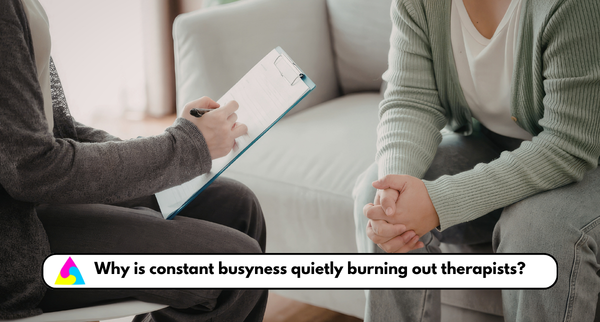
Therapists don’t usually question busyness. In many ways, it’s built into the role. A full caseload means you’re helping. Back-to-back sessions mean you’re in demand. Holding space all day means you’re doing meaningful work. On the surface, it all looks aligned with purpose. But here’s where it gets complicated—being constantly “on” for others isn’t the same as being well yourself. Over time, busyness stops being about impact and starts becoming a pattern your nervous system gets stuck in. Because when your day finally slows down, even for a moment, everything you’ve been holding—your own thoughts, emotions, and fatigue—begins to surface. So instead of pausing, many therapists stay in motion. Notes, emails, planning, catching up. Anything to avoid that uncomfortable stillness.
This is how burnout quietly develops in the therapy profession. Not through sudden breakdown, but through subtle disconnection. You’re still showing up for your clients. Still listening, reflecting, supporting. But internally, something feels off. You might notice you’re more tired than usual, but rest doesn’t fully restore you. Your mind keeps replaying sessions or anticipating the next one. You feel present for others, yet distant from yourself. That’s because burnout for therapists isn’t just about workload—it’s about continuous emotional attunement without enough recovery. Society often reinforces the idea that you should keep producing, keep showing up, and not reveal exhaustion or vulnerability . In a helping profession, that pressure becomes even stronger. You’re the one others rely on. So you keep going.
What Busyness Looks Like for Therapists
For therapists, busyness isn’t just about tasks—it’s about emotional presence.
It often shows up as:
Back-to-back client sessions with little time to reset
Carrying emotional residue from one session into the next
Using admin work to avoid slowing down between clients
Feeling uneasy when there’s space in your schedule
Staying mentally “on” even after work hours
At first, this feels like dedication. But over time, it becomes draining. You’re constantly giving, but not always replenishing.
The Hidden Cost of Always Holding Space
Therapists are trained to regulate others—but that doesn’t mean your system doesn’t feel the impact.
When you’re always attuned to others:
Your nervous system stays in a heightened state of awareness
Your body doesn’t fully return to baseline between sessions
Emotional fatigue builds, even if you’re not consciously aware of it
You might notice:
You feel “on edge” even when your day ends
You struggle to fully switch off
You feel emotionally flat instead of fulfilled
You start questioning your capacity or effectiveness
This isn’t a lack of skill. It’s a lack of recovery.
Why Slowing Down Feels Uncomfortable for Therapists
Here’s something many clinicians don’t talk about openly—slowing down can feel harder than staying busy.
Because underneath the pace, there’s often:
A sense of responsibility toward clients
Guilt about not “doing enough”
Fear of falling behind professionally
Discomfort in turning attention back toward yourself
When your role is to hold space for others, it can feel unfamiliar—sometimes even unsettling—to sit with your own internal experience.
The Shift: From Constant Attunement to Sustainable Practice
Burnout recovery for therapists doesn’t mean caring less. It means creating space to care sustainably.
That shift can start with small, intentional changes:
Taking short pauses between sessions to reset your nervous system
Allowing moments of stillness without filling them immediately
Noticing when you’re carrying emotional residue—and releasing it
Setting boundaries around your time, energy, and availability
These aren’t luxuries. They’re part of maintaining clinical presence over time.
A Simple Reset Between Sessions
Try this between clients:
Sit still for 60 seconds
Notice your breath without changing it
Feel your feet on the ground or your body in the chair
Let the previous session “end” in your system
It’s simple. But it creates separation—and that matters more than you think.
Final Thought
You became a therapist to help others. But sustaining that work requires including yourself in the process. You don’t need to earn rest after burnout—you need to build it into the way you work. Because the goal isn’t just to keep going. It’s to keep going well. And that only happens when your system has space to reset, not just perform.
A Question Worth Sitting With
What if your exhaustion isn’t because you’re doing too much work… but because you’re doing too much without space to recover from it?