Why Burnout Isn’t Just Exhaustion — It’s What Happens When Therapists Stop Feeling
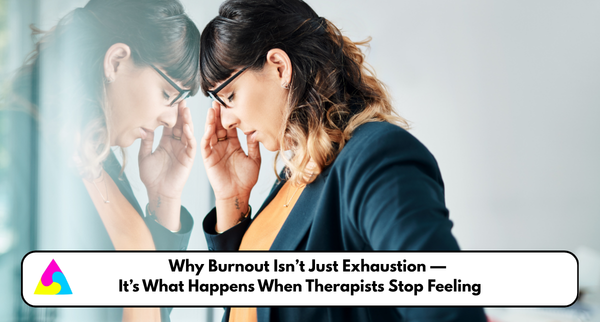
Therapists are trained to feel—to notice, to attune, to hold space for what others are going through.
But over time, something subtle can shift.
You’re still showing up, still doing the work, still supporting your clients in meaningful ways.
Yet internally, things can start to feel… quieter. Not peaceful quiet—more like emotional distance.
You’re present, but slightly removed. Engaged, but it takes more effort than it used to.
This is where burnout often begins for therapists—not as a dramatic collapse, but as a gradual disconnection from your own internal experience.
Because when your role requires you to consistently prioritize others’ emotions, your own can slowly get pushed aside.
At first, this adaptation makes sense.
Therapy is emotionally demanding, and your system finds ways to keep you functioning.
You move efficiently from one session to the next. You focus on techniques, interventions, and outcomes. You stay “on” for your clients.
But in doing so, you may begin to bypass what you’re feeling in real time.
Many of us operate within social expectations that prioritize performance and composure over vulnerability, which can create a growing distance between who we are and how we show up.
In our helping profession, that gap can widen quietly.
You don’t stop caring—but you may start feeling less connected to that care.
Burnout as Emotional Backlog
Burnout isn’t always about workload.
It’s often about accumulation.
Unprocessed stress. Unfelt grief. Unacknowledged frustration.
Emotions that were never given space don’t disappear. They stay stored — in the body, in the nervous system, in subtle patterns of tension and fatigue.
Eventually, the system becomes overloaded.
Not because you’re weak. But because you’ve been carrying more than you’ve been processing.
The Energy It Takes to Not Feel
It’s easy to assume that feeling emotions is what drains us.
But in many cases, the opposite is true.
Suppressing emotions requires effort. Constant effort.
It shows up as:
Staying “composed” when you’re overwhelmed
Avoiding certain thoughts or conversations
Distracting yourself when discomfort arises
Pushing through when your body is asking you to pause
Each of these takes energy.
And when it becomes a daily pattern, that energy depletion starts to feel like burnout.
The Two Patterns That Keep You Stuck
When emotions do break through, people often fall into one of two patterns:
1. Becoming the Emotion
“I’m anxious.” “I’m overwhelmed.”
The feeling takes over completely.
2. Avoiding the Emotion
Scrolling. Working. Staying busy.
Anything to not feel what’s underneath.
Your source highlights how people often move back and forth between these two states — overwhelmed internally while appearing functional externally
This internal tension is exhausting.
It creates a kind of invisible burnout — one that isn’t always obvious, even to yourself.
Your Body Is Already Processing — You’re Just Interrupting It
Here’s something most people don’t realize:
Your body already knows how to process emotions.
An emotion is a physiological event — a surge of neurochemicals moving through your system.
And according to research, that process can complete itself relatively quickly…
If it’s not interrupted.
But we interrupt it all the time.
By thinking about it. Analyzing it. Resisting it. Avoiding it.
And every time we do, we extend the emotional cycle.
What could pass in moments ends up lingering for hours, days, or longer.
Why Burnout Feels Like Disconnection
When emotional suppression becomes habitual, something subtle happens:
You don’t just avoid difficult emotions. You begin to lose access to positive ones too.
Joy feels muted. Connection feels distant. Meaning feels harder to access.
As your source notes, when emotions are suppressed, life can start to feel like an endless to-do list rather than a lived experience
This is the deeper layer of burnout.
Not just exhaustion — but disconnection from yourself.
The Role of Fear Beneath It All
Many burnout-related emotions — worry, anxiety, doubt — share a common root:
Fear of:
Not being enough
Falling behind
Being judged
Losing control
Instead of addressing that fear directly, we often manage it by staying busy, productive, or “on top of things.”
But the fear doesn’t go away. It just goes underground.
And over time, it becomes chronic tension in the system.
What Happens When You Start Feeling Again
At first, reconnecting with emotions can feel uncomfortable.
Even overwhelming.
Because you’re not just feeling what’s happening now — you’re also touching what’s been stored.
But something important begins to happen:
The pressure starts to release.
You may notice:
A sense of lightness
More emotional clarity
Less internal resistance
A gradual return of energy
As your source suggests, when you stop pushing emotions away and allow them to be felt, the exhaustion begins to lift
Not instantly. But steadily.
A Different Way to Relate to Emotions
What if emotions weren’t something to control… but something to experience and move through?
A simple shift can make a big difference:
Instead of: “I am anxious”
Try: “I’m experiencing anxiety right now.”
That small change creates space.
It reminds you:
The emotion is temporary
It’s not your identity
It can move through you
A Practice You Can Try Today
You don’t need a perfect routine to begin.
Just a moment of awareness.
Next time you feel something uncomfortable:
Pause
Notice the feeling
Locate it in your body
Breathe slowly, especially focusing on longer exhales
Let the sensation be there without trying to change it
Even 60–90 seconds of this can shift your experience.
Not by forcing the emotion away, but by allowing it to complete its cycle.
Rebuilding Trust With Yourself
Burnout recovery isn’t just about rest.
It’s about rebuilding a relationship — with your body, your emotions, and your internal signals.
Over time, you begin to trust that:
You can feel without being overwhelmed
You can slow down without losing control
You can experience discomfort without avoiding it
And from that place, something changes.
Life feels less like something you’re managing… and more like something you’re actually living.
A Final Reflection
If you’re feeling burned out, it doesn’t necessarily mean you’ve been doing too much.
It may mean you’ve been feeling too little of what matters — and too much of what’s been left unresolved.
And the way forward isn’t always more productivity, more discipline, or more control.
Sometimes, it’s something much simpler.
Learning to pause. To notice. To feel.
Because the truth is:
You don’t heal by avoiding your emotions. You heal by allowing them to move through you.