Therapist Burnout Isn’t a Motivation Problem. It’s What Happens We Forget How to Rest
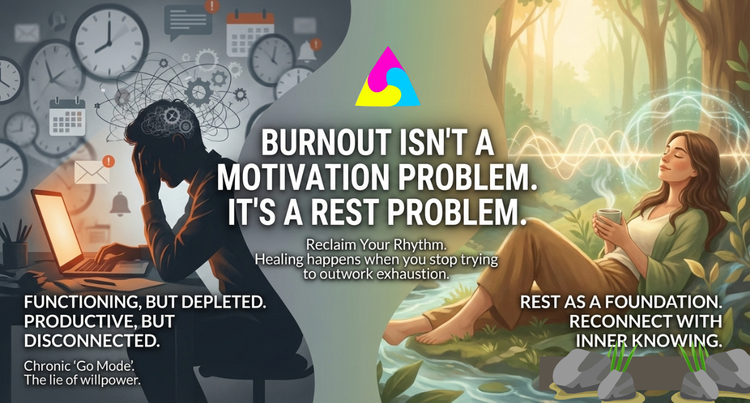
Burnout Isn’t a Motivation Problem. It’s a Rest Problem.
Most people don’t burn out because they don’t care enough. They burn out because they’ve cared for too long without real rest.
Burnout rarely shows up as a dramatic breakdown. More often, it looks like this:
You’re functioning—but depleted. You’re productive—but disconnected. You’re “fine”—but deeply tired.
And because you’re capable, driven, and responsible, you keep pushing.
The Lie We’ve Been Taught About Burnout
We’re told burnout means:
Poor boundaries
Weak resilience
Not managing time well enough
So we respond by doing more: More planning. More self-care tasks. More effort to “get back on track.”
But burnout doesn’t resolve through willpower.
When you’re burned out, your nervous system has forgotten how to rest. Everything stays in high-speed mode—your thoughts race, emotions fluctuate, and slowing down feels uncomfortable or even unsafe.
That’s not a personal flaw. That’s biology.
Why Rest Feels So Hard When You Need It Most
Burnout is a state of chronic “go mode.”
Your system is trained to stay alert, responsive, and productive—long after it’s healthy to do so. Over time, rest starts to feel like laziness. Pausing feels wrong. Slowing down creates guilt.
So instead of recovering, you push harder.
And that’s how burnout deepens.
A Different Way Forward
A holistic approach to burnout recovery begins with a radical shift: Valuing rest as much as productivity.
Not rest as a reward. Not rest as something you “earn.” Rest as a foundational requirement for clarity, creativity, and sustainable performance.
When you slow down intentionally:
Your nervous system recalibrates
Your mind becomes quieter
Your emotions become more manageable
You don’t lose momentum—you gain direction.
The Role of Inner Knowing
Have you ever noticed how life feels when things are aligned?
Decisions come easily. Ideas flow. You feel grounded, confident, and clear.
That’s what happens when you’re connected to what I call your Inner Knowing—the internal guidance system that gets drowned out by chronic stress and constant urgency.
You don’t access it by thinking harder. You access it by slowing down enough to listen.
Burnout Is Not a Failure
Burnout isn’t a sign that you chose the wrong path. It’s a sign that the way you’ve been sustaining your life is no longer sustainable.
There’s no shortcut out of burnout. No checklist. No one-size-fits-all fix.
Healing happens when you reconnect your mind and body, honor your humanity, and stop trying to outwork exhaustion.
A Reminder You Might Need Today
You are not broken. You are not lazy. You are not failing.
Your system is simply asking for something different.
And when you begin to listen—truly listen—burnout becomes less of a collapse and more of an invitation to build a life that actually supports you.
What would change if rest wasn’t something you felt guilty for—but something you trusted?