When Burnout Feels Like Being Stuck: A Nervous System Perspective for Therapists
Life doesn’t actually have to be this hard — and yet, for many of us, it feels that way.
There are moments when something simple arises — an upcoming session, a deadline, a conversation — and instead of responding with clarity, there’s an internal paralysis. A subtle but pervasive stuckness. Not dramatic. Not obvious. Just enough to make everything feel heavier than it needs to be.
Therapists are particularly good at pushing through this type of experience. We intellectualize it, normalize it, and tell ourselves it’s “part of the work.” But over time, this internal stuckness compounds. Life becomes more complicated, more exhausting, and less spacious — even when nothing outwardly catastrophic is happening.
This is one of the quiet pathways into burnout.
How We Think Ourselves Into Burnout
Human beings have remarkably powerful brains. We can think ourselves into nearly anything.
But thinking ourselves out of chronic stress is far more difficult, if not impossible.
Burnout often develops when we over-rely on thinking, analyzing, and pushing as solutions. We keep doing — believing that if we just work harder, stay more organized, or hold it together a bit longer, something will eventually shift.
Instead, we become more depleted.
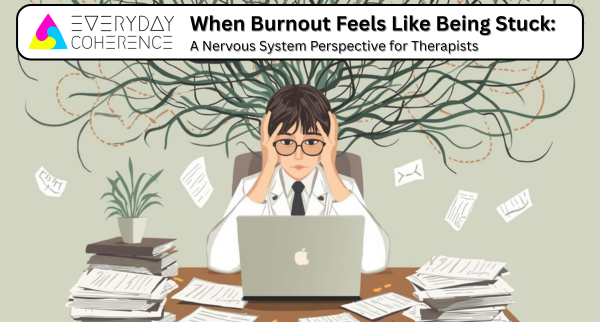
Burnout is like thinking ourselves into a corner with no visible exit. So we push harder into that corner, hoping it will budge — while our energy, creativity, and joy slowly drain away.
For therapists, this pattern is especially common. We are trained to hold space, conceptualize, and make meaning. These are powerful skills — but they are not enough to resolve burnout on their own.
Why Feeling “Stuck” Feels So Permanent
One of the most disorienting aspects of burnout is how convincing it is.
When you’re burnt out, your internal experience tells you:
This is just how my life is.
There’s no wiggle room.
Every day feels like the same grind.
Burnout tricks the nervous system into believing there is no alternative. This isn’t because change is impossible — it’s because stuckness has become a habitual state.
Habits, however, are not permanent.
Small, subtle shifts — practiced consistently and consciously — can create profound change. Burnout is not a life sentence. It’s a signal. A wake-up call inviting a course correction.
You didn’t choose for your life to feel exhausting or disconnected. And yet, here you are.
The good news? The clarity, vitality, and sense of purpose you’re longing for are not missing — they’re simply obscured by chronic stress.
Burnout Is Not a Personal Failure
Burnout has quietly become the norm, especially in helping professions. And yet, it remains deeply isolating.
Many therapists experience burnout internally while outwardly appearing “fine.” Competent. Reliable. Put together.
You might observe colleugues and wonder, Why does everyone else seem to be managing better than I am? What’s wrong with me?
There is nothing wrong with you.
In fact, in 2019 the World Health Organization officially classified burnout as a workplace syndrome resulting from mismanaged chronic stress. It’s not a weakness — it’s a physiological and psychological response to prolonged overload.
Burnout shows up differently for everyone. For some, it’s exhaustion. For others, anxiety, irritability, sleep disruption, cynicism, loss of purpose, or physical symptoms like headaches and digestive issues.
These symptoms are not the problem — they are messengers.
A Nervous System View of Burnout
At its core, burnout is a nervous system issue.
Your autonomic nervous system is your internal stress-management system. It’s designed to move fluidly between:
Parasympathetic mode (rest, recovery, connection)
Sympathetic mode (action, alertness, survival)
In a healthy system, these states work in harmony.
Burnout happens when the system gets stuck.
For many therapists, the nervous system becomes locked in a state of chronic high alert — survival mode. Emails, documentation, crisis management, emotional labor, and constant availability become modern-day “saber-toothed tigers.”
Your rational mind knows an email isn’t life-threatening. But the more primitive parts of the brain don’t.
Over time, cortisol floods the system. Rest begins to feel unsafe. Slowing down feels dangerous. The body forgets how to return to baseline.
This is what creates the feeling of being “always on.”
Burnout Culture and the Helping Professions
We live in a culture that glorifies productivity, urgency, and constant responsiveness. Mental health professionals are not immune to this — in many ways, they are more vulnerable to it.
Therapists are expected to:
Be emotionally available
Manage increasing caseloads
Navigate systemic constraints
Maintain ethical presence
Care deeply, consistently, and compassionately
All while living in a world that rarely pauses.
It’s no wonder burnout has become widespread.
But here’s the truth that burnout often hides: The larger systems may be broken — but you are not.
And you don’t need to hit rock bottom to make changes.
Burnout as an Invitation, Not a Collapse
Burnout is painful — but it’s also informative.
It’s your body and mind saying: The way I’ve been handling stress is no longer working.
Recovery doesn’t require abandoning your profession or becoming less caring. It requires learning how to regulate your nervous system so that survival mode is no longer your default state.
When regulation returns, something shifts:
Perspective widens
Energy becomes more accessible
Presence feels possible again
Wellness is not mere survival. It’s reclaiming who you are beyond chronic stress.
If you’re feeling stuck, exhausted, or disconnected, know this: change is possible — and it begins with awareness, compassion, and small, consistent shifts.
Remember, you are not broken. Your nervous system has simply been under too much strain for too long.
A Closing Reflection
What if therapist wellness wasn’t treated as optional or secondary — but as essential?
What if burnout is understood not as failure, but as a call to reorganize life in a way that truly supports the nervous system?
You don’t have to keep forcing. There are other ways forward.